|
|
|
|
|
|
|
|
|
|
|
|
Vincit Omnia Veritas: Collected Essays
Edited by Timothy Scott and Renaud Fabbri
|
Vincit Omnia Veritas was published biannually from January 2005 to July 2007. It was felt that the original articles produced for Vincit Omnia Veritas might be presented in a collected format. To that end, Religio Perennis, with the assistance of the Philosophy & Religious Studies program, La Trobe University, Bendigo, and Eye of the Heart: The Journal of Traditional Wisdom, is happy to offer the following collection of original essays. Vincit Omnia Veritas: Collected Essays includes works by Renaud Fabbri, Barry McDonald, Michael Fitzgerald, Timothy Scott, Rodney Blackhirst, Harry Oldmeadow and James Morris. Vincit Omnia Veritas: Collected Essays is made available as a print-on-demand publication through Eye of the Heart: A Journal of Traditional Wisdom and La Trobe University, Bendigo, Australia.
|
|
|
|
|
|
|
|
|
|
|
|
The Sophia Library
|
|
|
|
 |
The Sophia Library is an on-line library dedicated to the presentation of the timeless Truth underlying the diverse religions. This Truth, often referred to as the Sophia Perennis or Perennial Wisdom, finds its expression in the revealed scriptures, as well as in the writings of the great spiritual masters and in the artistic creations of the traditional worlds.
|
|
|
|
|
|
 |
|
If it were necessary or useful to prove the Absolute, the objective and trans-personal character of the human Intellect would be a sufficient testimony, for this Intellect is the indisputable sign of a purely spiritual first Cause, a Unity infinitely central but containing all things, an Essence at once immanent and transcendent. It has been said more than once that total Truth is inscribed in an eternal script in the very substance of our spirit; what the different Revelations do is to “crystallize” and “actualize”, in different degrees according to the case, a nucleus of certitudes that not only abides forever in the divine Omniscience, but also sleeps by refraction in the “naturally supernatural” kernel of the individual, as well as in that of each ethnic or historical collectivity or the human species as a whole.
(…) The essential function of human intelligence is discernment between the Real and the illusory or between the Permanent and the impermanent, and the essential function of the will is attachment to the Permanent or the Real. This discernment and this attachment are the quintessence of all spirituality; carried to their highest level or reduced to their purest substance, they constitute the underlying universality in every great spiritual patrimony of humanity, or what may be called the religio perennis; this is the religion to which the sages adhere, one which is always and necessarily founded upon formal elements of divine institution.
Frithjof Schuon, “Religio Perennis”, Light on the Ancient Worlds (Full article in PDF).
|
|
|
The Path of Beauty
|
|
|
|
|
|
|
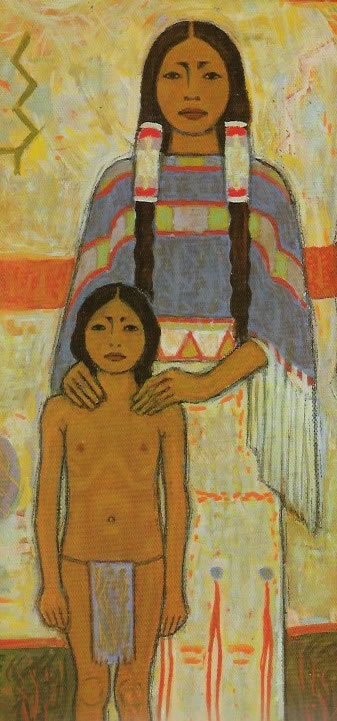
Frithjof Schuon, the most important twentieth-century exponent of the Philosophia Perennis, was not an artist interested in metaphysics; he was a metaphysician and his paintings appear rather as an expression of the aesthetic, psychological or moral dimension of the Philosophia Perennis. Frithjof Schuon also wrote thousand of didactic poems at the end of his life.
|
|
|
|
|
|
|
|
|
|
|
|
|
|